


Argan Oil in Skincare: What It Does and Who It Suits
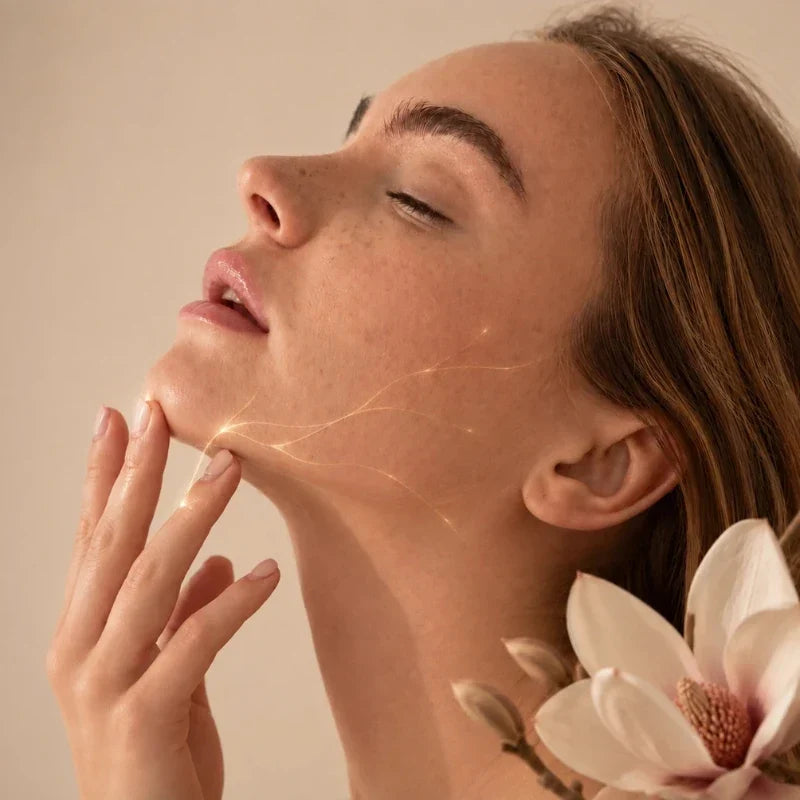
Argan oil is in almost every "natural" skincare range on the shelf, usually somewhere near the bottom of the ingredient list where it costs the brand very little to put it. In all three TandheM formulas it sits second, after water, which makes it the highest concentration active we use.
That is an unusual choice and it is worth explaining, because argan oil is also one of the most loosely described ingredients in the industry. This is what it actually is, what the fatty acids actually do, whether it blocks pores, and how to tell the cosmetic grade from the kind sold for bread.
What argan oil is and where it comes from
Argan oil is pressed from the kernels inside the fruit of Argania spinosa, a slow growing, thorny tree that survives on very little water and grows wild in one part of the world.
The tree
The argan forest, the Arganeraie, covers a stretch of southwest Morocco between Essaouira and Agadir. UNESCO designated it a Biosphere Reserve in 1998. The tree is remarkable less for the oil than for what it holds together: its roots stabilise soil at the edge of the desert, and the forest is one of the things slowing desertification in that region.
A mature tree produces enough fruit for roughly one litre of oil a year. That number explains most of what follows about price and about adulteration.
Who makes it
The labour is the expensive part. Each fruit is dried, the hard shell cracked by hand between two stones, and the kernels removed one at a time. Mechanisation has never fully solved the cracking step, which is why the work is still done by hand.
Most of it is done by women, organised into cooperatives across the region. UNESCO added the practices and knowledge around the argan tree to its Intangible Cultural Heritage list in 2014, and the cooperative model is the reason a rural, largely female workforce captures a meaningful share of the value rather than none of it.
This matters commercially as well as ethically. When you see argan oil priced like sunflower oil, something in that chain has been skipped.
The fatty acid profile, in plain language
Every plant oil is a mix of fatty acids, and the mix is what determines how the oil behaves on skin. Argan oil is roughly 80% unsaturated, and three components do most of the work.
Oleic acid, around 43 to 49%
Oleic acid is the omega-9 that also dominates olive oil. It is what makes an oil feel rich and cushioning, and it spreads easily. Oils high in oleic acid tend to feel more substantial on the skin and suit drier skin better.
Linoleic acid, around 29 to 36%
Linoleic acid is the omega-6, and this is the number that makes argan unusual. Most oils are heavily weighted to one or the other. Argan sits close to the middle, which is why it works across a wider range of skin than either a high-oleic oil like olive or a high-linoleic oil like grapeseed.
There is a well documented observation in dermatology that the sebum of acne-prone skin tends to be relatively low in linoleic acid. That is an association rather than a treatment, and no cosmetic oil is a treatment for acne, but it is part of why a balanced oil is often tolerated by skin that reacts badly to heavier ones.
Tocopherols, the vitamin E
Argan oil carries a high natural tocopherol content, mostly gamma-tocopherol. Tocopherols are antioxidants, and they do two jobs at once: they help protect skin from the visible effects of free radicals, and they help keep the oil itself from going rancid. A cold pressed oil with its tocopherols intact has a longer, more stable life than one that has been stripped and re-fortified.
Does argan oil clog pores
The short answer is that it is among the least likely oils to do so, and that the scale everyone quotes is weaker evidence than it appears.
Where the comedogenic scale comes from
The 0 to 5 comedogenic ratings circulating on skincare blogs come from studies done in the 1970s and 1980s, most of them applying undiluted ingredients to the inside of a rabbit's ear. Rabbit ear follicles are not human facial follicles, the concentrations used were far above anything in a finished formula, and the same ingredient often scores differently across sources.
Argan oil is generally rated 0 on that scale. Treat that as a useful signal and not as a fact about your face.
What that means in practice
Two things predict whether an oil will cause congestion for you better than any published number. The first is its linoleic to oleic balance, where argan sits in a forgiving middle. The second is what else is in the formula, since an oil at 2% behind a heavy occlusive behaves nothing like the same oil pressed neat onto skin.
If you are prone to congestion, the honest advice is the same as for any new product: one change at a time, two weeks, one area of the face first.
Cosmetic grade versus culinary grade
These are two different products from the same kernel, and the difference is not marketing.
How to tell them apart
Culinary argan oil is pressed from kernels that have been roasted first. Roasting develops the flavour, which is why the oil is deep golden brown and smells distinctly of toasted nuts. It is delicious and it belongs on bread and in amlou.
Cosmetic argan oil is pressed from unroasted kernels. It is paler, closer to light gold, and its smell is mild and slightly grassy rather than nutty.
So: if the bottle in your bathroom smells strongly of roasted nuts, it was made for your kitchen. It will not harm your skin, but you are paying for a flavour you cannot use and an oil that oxidises faster once opened.
Deodorised argan
Some cosmetic argan is deodorised to remove even the faint natural scent, usually so it can sit in a fragranced formula without arguing with the perfume. Deodorising is a heat and steam process and it costs some of the minor constituents. Neither choice is wrong. It is worth knowing which one you are buying.
What to look for on a label
The INCI name is Argania Spinosa Kernel Oil. Where it sits in the list tells you roughly how much is present, since ingredients run in descending order of concentration down to 1%. An oil named in the marketing copy but sitting in the last third of the INCI is present in a quantity that does very little.
Who it suits and who should be careful
Argan oil suits dry, dehydrated and normal skin straightforwardly. It suits mature skin, where the cushioning from the oleic acid is welcome. It generally suits sensitive and reactive skin better than most plant oils, which is the reason it anchors our formulas rather than appearing as a garnish in them.
Be careful in two cases. If you have a tree nut allergy, note that argan is botanically a drupe rather than a true nut, but the kernel is nut-like and cross-reactivity is not impossible. Patch test, and if your allergy is severe, ask an allergist rather than the internet.
And if your skin is very oily and congestion-prone, a lighter formula may suit you better, not because argan is comedogenic but because a rich texture on already oily skin is simply uncomfortable.
Where argan oil fits in a neurocosmetic formula
This is the part that explains the concentration. Neurocosmetics is skincare formulated for how skin behaves under stress rather than only for what it lacks. Skin is a sensory organ threaded with nerve endings, and when someone is under pressure their skin usually changes before anything else does: tighter, more reactive, less predictable.
Formulating for that has one consequence above all others. Every active has to be chosen for tolerance before performance, because an ingredient that gives a better result on paper and a sting in practice is worth nothing to someone whose skin is already reacting to everything.
Argan oil is what a tolerance-first brief looks like when you follow it honestly. It is well tolerated across skin types, its fatty acid balance is moderate rather than extreme, it nourishes and softens, and skin feels comfortable rather than tight after it. It is not the most fashionable ingredient we could have put second in the list. It is the one that behaves.
It sits alongside the other actives in NB|C™, our NeuroBalance Complex™: marine postbiotics, bakuchiol, biomimetic tripeptides and humectants, all chosen the same way.
In the Pro-Aging Essential Face Serum
In the Pro-Aging Essential Face Serum, argan oil carries bakuchiol, a plant-derived alternative to retinol, along with sodium hyaluronate and hydrolysed soy protein. Skin looks smoother and more even, and fine lines appear less visible, without the irritation or the adjustment period retinol asks for. 30 ml.
In the Advanced Facial Cream
In the Advanced Facial Cream, argan oil sits above shea butter, sodium PCA and Terminalia ferdinandiana, the Kakadu plum. This is the formula where the oleic acid earns its place: skin feels comfortable rather than tight at six in the evening, not only at nine in the morning. 50 ml.
In the Active Botanical Eye Contour
In the Active Botanical Eye Contour, argan oil supports the most demanding brief of the three, since the eye area is the least forgiving skin on the face. That formula is fragrance-free throughout. 15 ml.
All three are vegan, V-Label certified and made in Portugal. In a consumer self-assessment on 18 women aged 27 to 50, over 30 days, 94% saw brighter, smoother-looking skin.
Questions people ask
Can I use pure argan oil instead of a moisturiser?
You can, and plenty of people do. An oil alone slows water loss but adds no water, so it works best applied to skin that is still damp. A formulated product combines humectants that draw water in with oils that slow its escape, which is why the two together outperform either alone.
Morning or evening?
Either. Argan oil is not photosensitising. On oilier skin it may sit better in the evening simply because of how it feels under make-up.
Does argan oil expire?
Yes. A cold pressed cosmetic argan oil keeps its character for around a year to eighteen months after opening if it is stored away from heat and light. If it smells sharp or like old crayons, it has oxidised. In a formulated product the period after opening symbol on the pack is your guide.
Is argan oil vegan?
Yes. It is pressed from the kernel of a fruit. Goats famously climb argan trees to eat the fruit, and there was a historical practice of collecting kernels from goat droppings, but no commercial cosmetic argan oil is produced that way today.
How much argan oil is actually in most products?
Far less than the front of the pack implies. Read the INCI list and see where it falls. In all three TandheM formulas it is second, after water.
Skin that reacts to everything needs ingredients chosen for tolerance first. Explore the formulas we make for it: TandheM Skincare for Skin That Reacts.
Read more
By Tânia Ferreira, psychologist and founder of TandheM. Time is not the only thing that shows on skin. Stress, sleep, grief and recovery leave a mark too. Her question is not what is wrong with you...
Almost everything written about dark circles assumes they are one thing. They are not. There are four separate causes, they look similar in a mirror, and they respond to completely different treatm...


